June 2024. One trip, one big loop: Cape Town to the Garden Route, up to Victoria Falls, through Johannesburg, and finishing in the bush at Madikwe. I have been to Africa before — Rwanda, a bridge, a million smiles — and I told myself I knew what to expect. I did not. South Africa is not one country in the way most countries are one country. It is several worlds taking turns in the same landscape, and just when you think you have it figured out, it hands you a waterfall that soaks you to the skin and a lion that looks straight through you. But I am getting ahead of myself — boots on the ground first, opinions after. That has always been the rule.
First, some general information — what on Earth is this place?
- Where: the southern tip of Africa, bordered by Namibia, Botswana and Zimbabwe to the north, Mozambique and Eswatini to the east, and two oceans — the cold Atlantic on the west, the warm Indian Ocean on the east. It is one of very few countries with another entire country inside it: Lesotho sits landlocked in its middle like a polite surprise.
- Size and people: roughly 1.2 million square kilometres and about 62 million people, the overwhelming majority of them warmer than the weather, which in June is saying something.
- Capitals: not one, not two, but three. Pretoria runs the government, Cape Town hosts Parliament, Bloemfontein handles the judiciary. Even the capitals job-share.
- Languages: twelve official ones — eleven spoken languages including isiZulu, isiXhosa, Afrikaans and English, plus South African Sign Language, added in 2023. English will get you everywhere; a smile gets you further.
- Money and time: the rand (ZAR), and South African Standard Time, UTC+2, all year round. No daylight-saving nonsense. A country after my own project-controls heart — the schedule is the schedule. And a word that will matter later: in June 2024 the rate sat near 18 rand to the US dollar, which means the dollar goes a long way in South Africa — uncomfortably long, if you enjoy wine. Hold that thought until Stellenbosch.
- When we went: June is winter. In Cape Town that means the rainy season, green hills and a mountain that plays hide and seek with the clouds. In the interior and the bush it is the dry season — cold mornings, golden grass, and animals gathering at the waterholes because there is nowhere else to drink. Timing, as always in life and in projects, is everything.
And the name you will hear everywhere: the Rainbow Nation, an expression coined by Archbishop Desmond Tutu and carried around the world by Nelson Mandela. Spend even a week there and you stop hearing it as a slogan. It is a description — of the people, the languages, the food, the music in a minibus taxi at a traffic light — and also, if I am honest, an aspiration the country is still working on, in full public view. More on that shortly, because you cannot write about South Africa and skip its history. Well, you can. Many do. I am not going to.
The history you walk through, whether you planned to or not
The short version, because the long version fills libraries. The Dutch East India Company landed at the Cape in 1652 and built a refreshment station for ships. Refreshment stations, like scope creep, have a way of becoming permanent. Colonisation followed, then the British, then gold and diamonds, and in 1913 the Natives Land Act restricted Black South Africans to roughly seven per cent of the land — their own land, in their own country. In 1948 the National Party made racial separation the formal law of the land and gave it a name: apartheid. The Group Areas Act sorted people into neighbourhoods by race. Pass laws controlled where Black South Africans could live, work and walk. The Bantu Education Act set out, deliberately, to prepare Black children for little more than servitude. When people protested at Sharpeville in 1960, police killed 69 of them. When schoolchildren in Soweto marched in 1976 against being taught in Afrikaans, the police shot them too, and the photographs went around the world.
I visited the sites, because reading about it at home and standing in it are two different educations. Robben Island, out in the cold Atlantic off Cape Town, is where Nelson Mandela spent 18 of his 27 years in prison, breaking rocks in a limestone quarry and somehow coming out the other side preaching reconciliation instead of revenge. The tours today are led by former political prisoners — men who were held in those same cells, telling you what the cell was like, in the first person. There is no narration on earth that competes with that. District Six, back in Cape Town, is quieter and in some ways harder: a vibrant, mixed, musical neighbourhood declared “white” in 1966, its more than 60,000 residents forcibly removed and their homes bulldozed. Much of it still sits there, grass and empty streets, a gap in the middle of a beautiful city, like a tooth nobody replaced.
Mandela walked free on 11 February 1990. In April 1994, South Africans of every race voted together for the first time, in queues that stretched for kilometres and were, by every account, the happiest queues in human history. He became president, served one term, and handed over power like a man returning a borrowed ladder. The Truth and Reconciliation Commission, chaired by Tutu, then did something almost no country has had the nerve to do: it put the wounds on the table, on television, in public, roughly 22,000 testimonies of them, on the theory that a nation, like a project in trouble, cannot recover what it refuses to look at honestly. I spend my working life in project controls. I know a lessons-learned exercise when I see one. That was the bravest one ever run.
Is it finished, healed, sorted? No. The inequality is visible, the politics are noisy, and South Africans will tell you so themselves, loudly, with jokes, usually within ten minutes of meeting you. But the direction of travel was set by people who chose the harder right over the easier revenge, and you feel that choice everywhere — in the people especially. The beauty of the Rainbow Nation is not that it is a rainbow. It is that it is a rainbow still being built, by hand, daily, with humour. Now — the lighter stuff, before I get emotional and ruin my reputation.
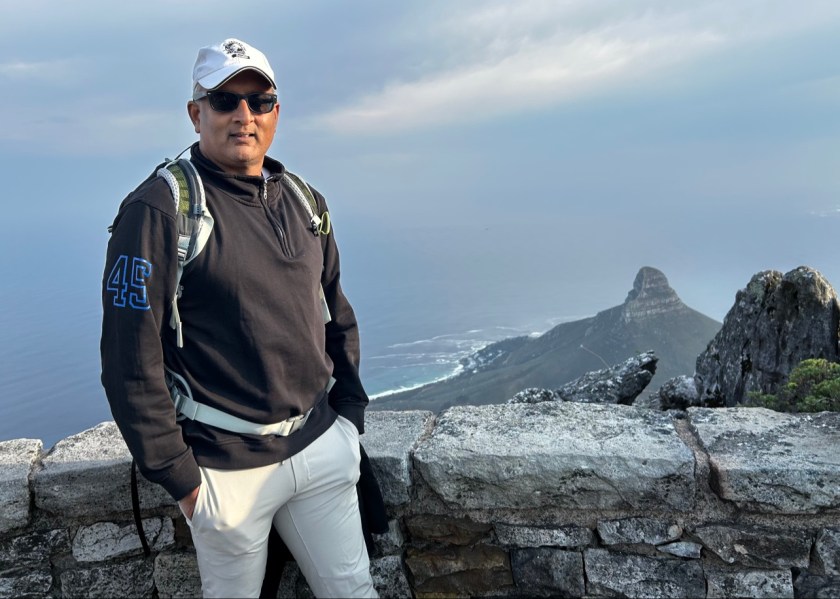
Cape Town — the city with a mountain for a roof
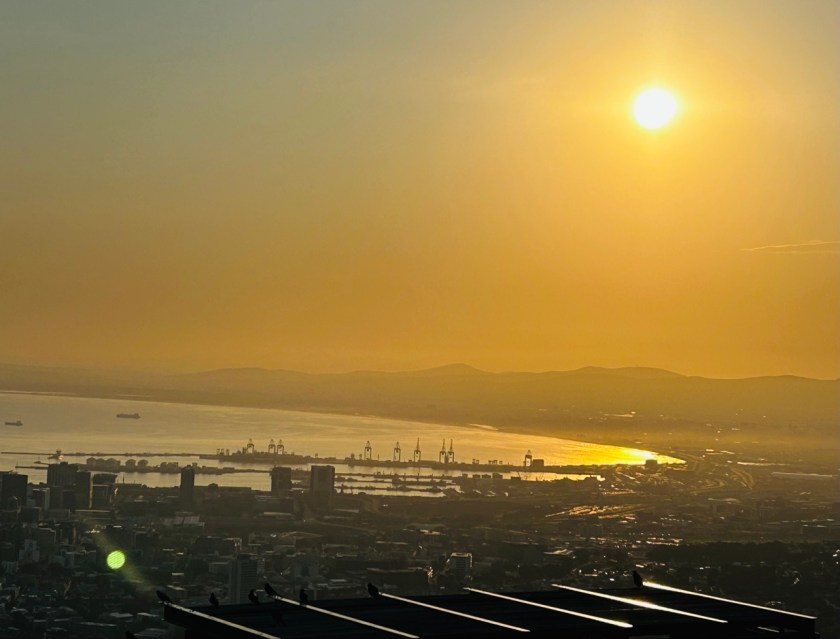
Cape Town does not so much have a view as it is one. Table Mountain stands over it at about 1,085 metres, flat as a dining table and older than the Himalayas, and the city arranges itself politely in the bowl beneath it. We went up early on the morning of 17 June, and the mountain gave us a sunrise I am still thinking about — the harbour below turning gold, the city waking up in miniature, a pair of birds sitting on the ledge beside us watching it all like two locals who have seen this show ten thousand times and still turn up. The cableway cars rotate as they climb, so everybody gets every view and nobody gets to hog the window. Good design. Equitable, democratic, very South African. I approved — and I almost never approve of machinery before coffee.
From the top you can pick out Lion’s Head, the 669-metre peak next door that does look, with a little goodwill, like a lion lying down watching the Atlantic. Robben Island sits out in the bay, small and flat and easy to miss if you did not know. Knowing is the whole point of going.
And then, because no Cape Town account of mine would be honest without it: the bunny chow. Bunny chow is Durban’s gift to the world — a hollowed-out loaf of white bread filled to surrendering point with curry, invented by the city’s Indian community in the 1940s as a portable lunch, edible container and all, and containing, despite the name, precisely no bunny. Cape Town serves it proudly, and I ordered one the way I order most things in a new city: confidently, and without asking the only question that mattered, which was how hot. The answer arrived. Tears were induced — I am not too proud to print that. Steam, I am fairly certain, exited through every available orifice, some of which I did not know were rated for steam. The bread conducted a heroic rescue operation, bite by bite, and I finished it anyway, because it was magnificent. South Africa’s Indian community seasoned that loaf under some of the harshest decades in the country’s history and still produced joy in bread form. Remember that the next time somebody tells you food is just food.
Stellenbosch and the Cape of Good Hope — wine, gables and the end of the map
Stellenbosch, founded in 1679 and the second-oldest town in the country, is what happens when Cape Dutch gables, oak trees and very serious wine all move into the same postcode. Vineyards run up to the mountains in green rows so straight they would satisfy a scheduler. The wines need no publicity from me — the world already knows — but I will say this: a tasting room in the Winelands, winter sun, mountains doing their best impression of a wine label, is a persuasive argument for never checking your email again. I resisted. Mostly.
And now the exchange rate enters the story, grinning. At roughly 18 rand to the dollar, a full tasting flight at a serious Stellenbosch estate — several wines, a beautiful room, a mountain view thrown in free — came to less than the price of a single glass in many American wine bars, and the bottles I carried away cost what I would pay for an unremarkable Tuesday bottle at home. I am a project-controls man; I live by budgets, baselines and the sacred discipline of never gold-plating scope. In the Winelands I gold-plated. If you visit with a strong currency, my advice is to decide your wine budget in advance, in writing, in the presence of witnesses, because the rand will talk you out of your principles one glorious tasting at a time.
The Cape of Good Hope, down the Peninsula, is where the map starts running out. Bartolomeu Dias rounded it in 1488, Vasco da Gama followed in 1497, and for centuries it was the great crossroads of the sea route to the East. Two things to get right, because I got both wrong until I stood there: it is not the southernmost tip of Africa — that honour belongs to Cape Agulhas, about 150 kilometres away — and the two oceans do not officially shake hands here, whatever the gift shops imply. What it is, is wild: cliffs, fynbos scrub full of plants found nowhere else on Earth, baboons with the confidence of small landlords, and wind with a personal grudge. The Flying Dutchman funicular takes you up to the old lighthouse, which I used without a shred of guilt. I have climbed enough mountains voluntarily; the knees file their grievances in writing these days.
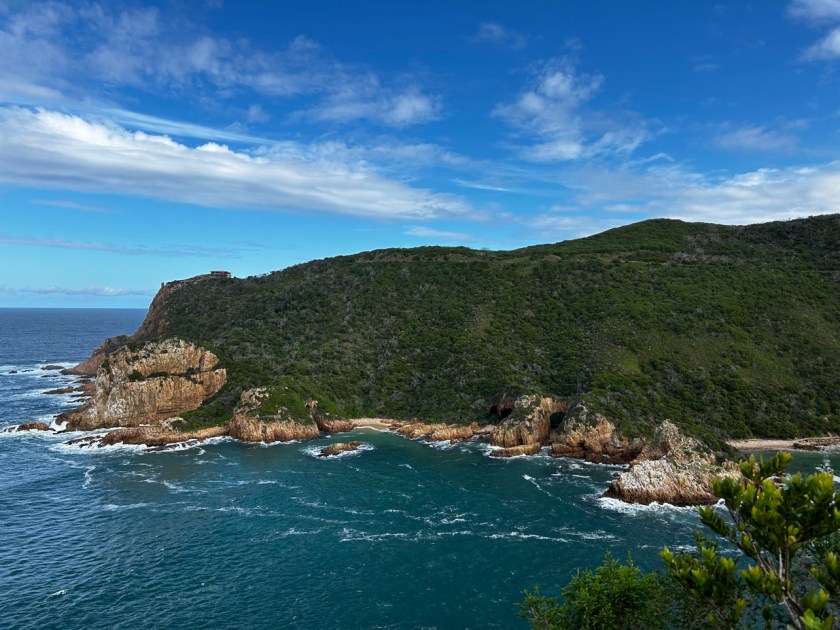
The Garden Route and George — 300 kilometres of showing off
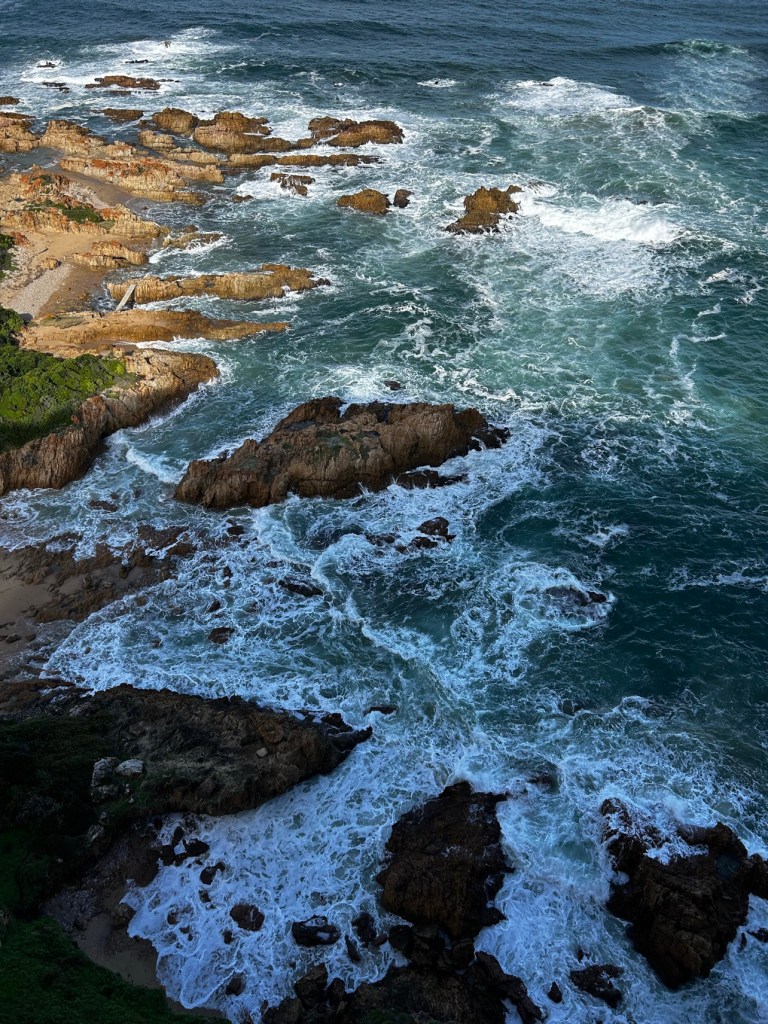
From Cape Town we turned east onto the Garden Route, roughly 300 kilometres of coastline from Mossel Bay to the Storms River that manages to fit in lagoons, forests, cliffs and beaches like it is trying to win an argument. The photographs do the talking here: an emerald headland with the Indian Ocean — the warm one, the sensible one — breaking white against the rocks below, and surf hammering into coves in a way that makes you very glad to be watching from above with both feet on dry land and a railing nearby.
George, the route’s main town, was proclaimed in 1811 and named for King George III, which tells you the naming committee was not overthinking things that year. What George has, beyond the name, is the Outeniqua Mountains standing over it like a green wall, some of the finest golf country anywhere (I behaved myself; the clubs stayed home), and the feeling of a town that knows it lives somewhere beautiful and has decided not to make a fuss about it. The Garden Route generally works like that. Knysna’s lagoon and oysters get the fame, Tsitsikamma’s forests and suspension bridges get the adrenaline, and the whole road gets driven far too fast by people in a hurry to arrive — a mistake. This is a stretch of Earth that rewards the slow schedule. Float, as we say in my line of work, is not wasted time. Sometimes float is the whole point.
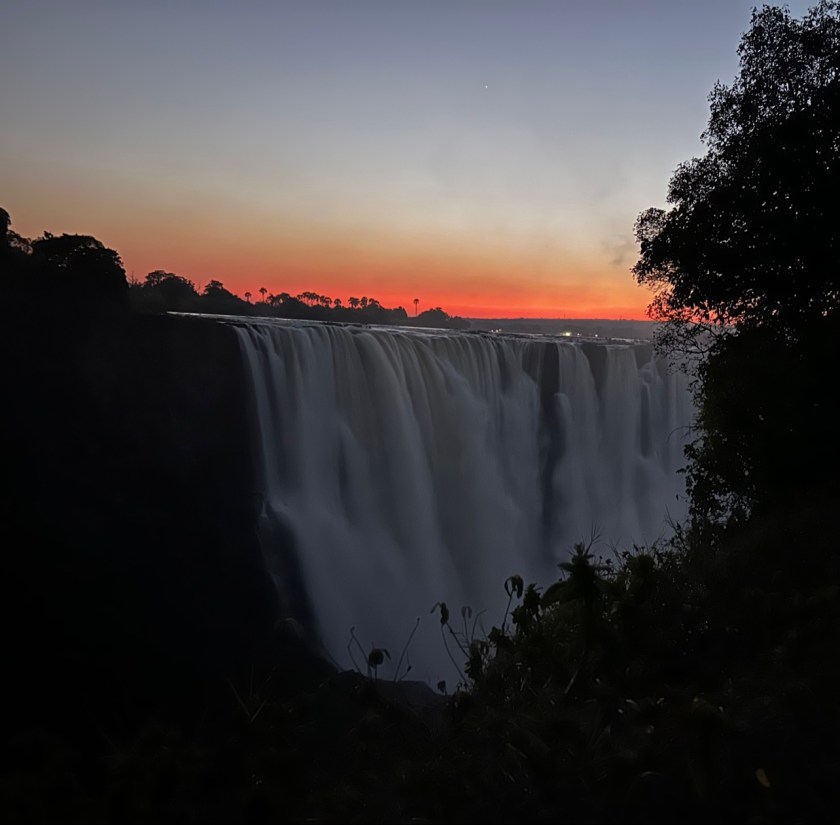
Victoria Falls — the Smoke That Thunders, and yes, you get wet
After George we flew north to Zimbabwe and the Zambezi. The local name for Victoria Falls is Mosi-oa-Tunya — The Smoke That Thunders — and I want to state for the record that it is the most honest piece of tourism branding on the planet. David Livingstone arrived in 1855 and named the falls for Queen Victoria, which was the fashion of the time; the smoke and the thunder were already there and did not require naming.
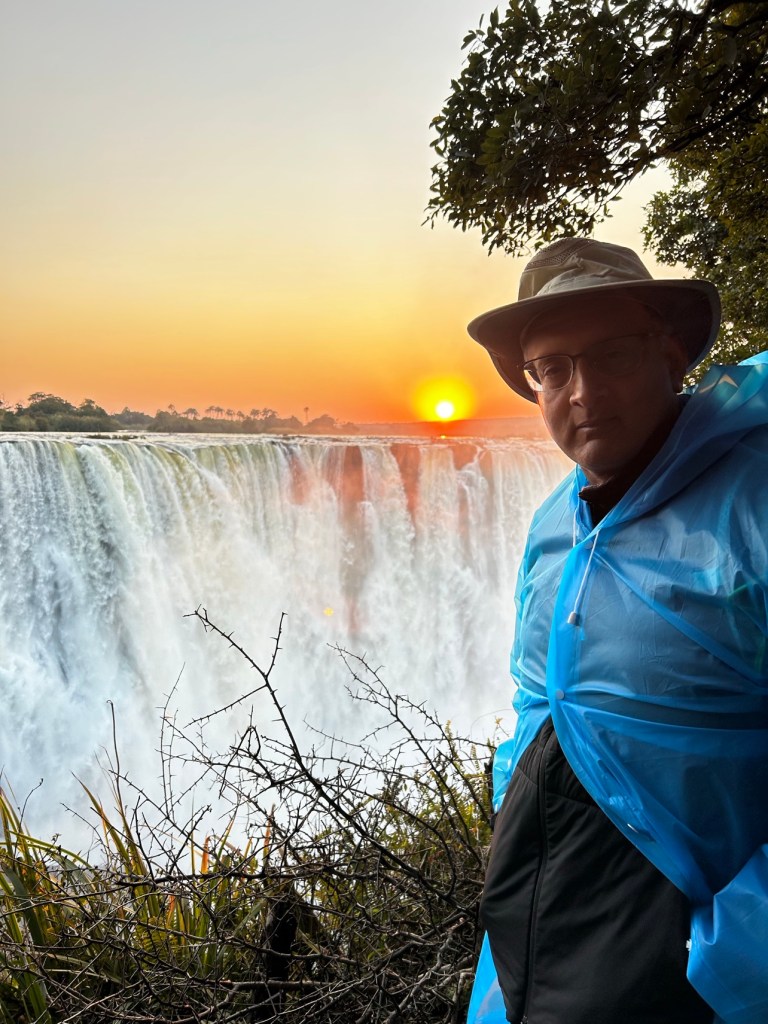
The numbers first, because numbers are my love language: about 1,708 metres wide and 108 metres high, the largest single sheet of falling water on Earth. We went at dawn on 21 June, just after the wet-season peak, which means the river was still running near full theatre. The sky burned orange behind the spray, the mist rose above the gorge like — well, like smoke, thundering. You hear it before you see it, and you feel it in your chest shortly after.
And then there is the poncho. At the entrance they issue you a rain poncho, and a first-timer makes the mistake of thinking this is a cheerful souvenir. It is not. It is a formal warning. The falls manufacture their own weather — the spray comes up out of the gorge and comes down again as rain with momentum — and within ten minutes of the viewpoints I was wearing the blue poncho like a man who had lost an argument with a car wash. Do as I say in the tips below, not as I did in the photographs. The camera survived; the dignity was declared a write-off somewhere around viewpoint nine. Worth it. Completely, entirely worth it. Stand there at sunrise, soaked, laughing, listening to a mile-wide river throw itself off a cliff, and try to think about your inbox. You will fail. That failure is the product being sold, and it is underpriced.
Johannesburg — the city of gold, with a long memory
Johannesburg exists because of gold, found in 1886, and everything about the place still moves at the speed of a man who thinks he might get rich by Friday. It is the country’s biggest city and its economic engine, and it does not do quaint. What it does do, seriously and well, is memory. The Apartheid Museum, opened in 2001, starts by handing you a ticket that randomly classifies you as white or non-white and sends you through separate entrances — you understand the system in your stomach before you read a single panel, which is exactly the idea. Out in Soweto, Vilakazi Street holds a distinction no other street on Earth can claim: it was home to two Nobel Peace Prize winners, Mandela and Tutu. One street. Two Nobel laureates. People still live their ordinary lives along it, which is the most Soweto thing imaginable — history there is not under glass, it is doing the school run.
And then, because I am who I am, a word for the Wanderers. Cricket people call the old ground the Bullring, for the noise and the hostility of its crowd when the South Africans are on top — I have called it surreal before, and I stand by it. Every cricket nation has a fortress; this one barks. Standing in that city, with that history under your shoes and that stadium in your ear, you understand South Africans a little better: this is a people that holds its sorrows and its sport with the same two hands, firmly, and does not drop either.
Madikwe and Tau — where the animals hold the schedule
The finale: Madikwe Game Reserve, some 75,000 hectares of bush in the North West province, up against the Botswana border. Madikwe is a remarkable story in itself — farmland converted back to wilderness from 1991, restocked under Operation Phoenix, one of the largest game relocation programmes ever attempted, which moved more than 8,000 animals in. It is malaria-free, it holds the Big Five, and because cheetahs and wild dogs live there too, the local tally runs to a “Super Seven”, which is either excellent ecology or very good marketing, and I choose to believe both.
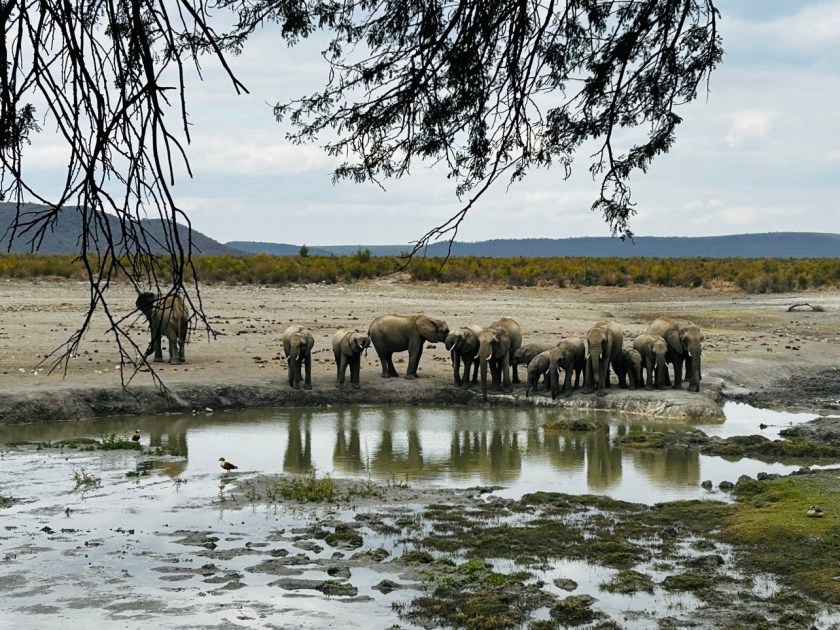
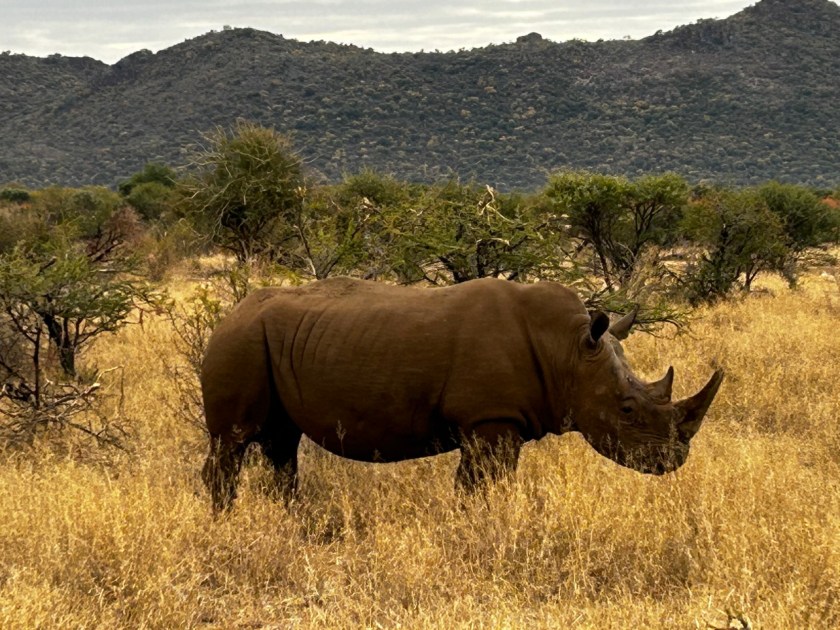
We stayed at Tau Game Lodge, in the Groot Marico country, overlooking its waterhole. Tau, for the record, is the Setswana word for lion — truth in advertising, as you will see. A lodge waterhole, properly run, is the finest theatre seat in Africa: you drink your coffee, and the programme arrives on its own four legs. Over our days there the waterhole and the drives delivered an elephant herd with calves lined up at the water like a family at a buffet, a rhino standing in grass the colour of ripe wheat doing absolutely nothing at a stately pace, two young elephants working off their opinions on each other, and a giraffe performing the full origami routine required for a tall animal to reach a low drink.
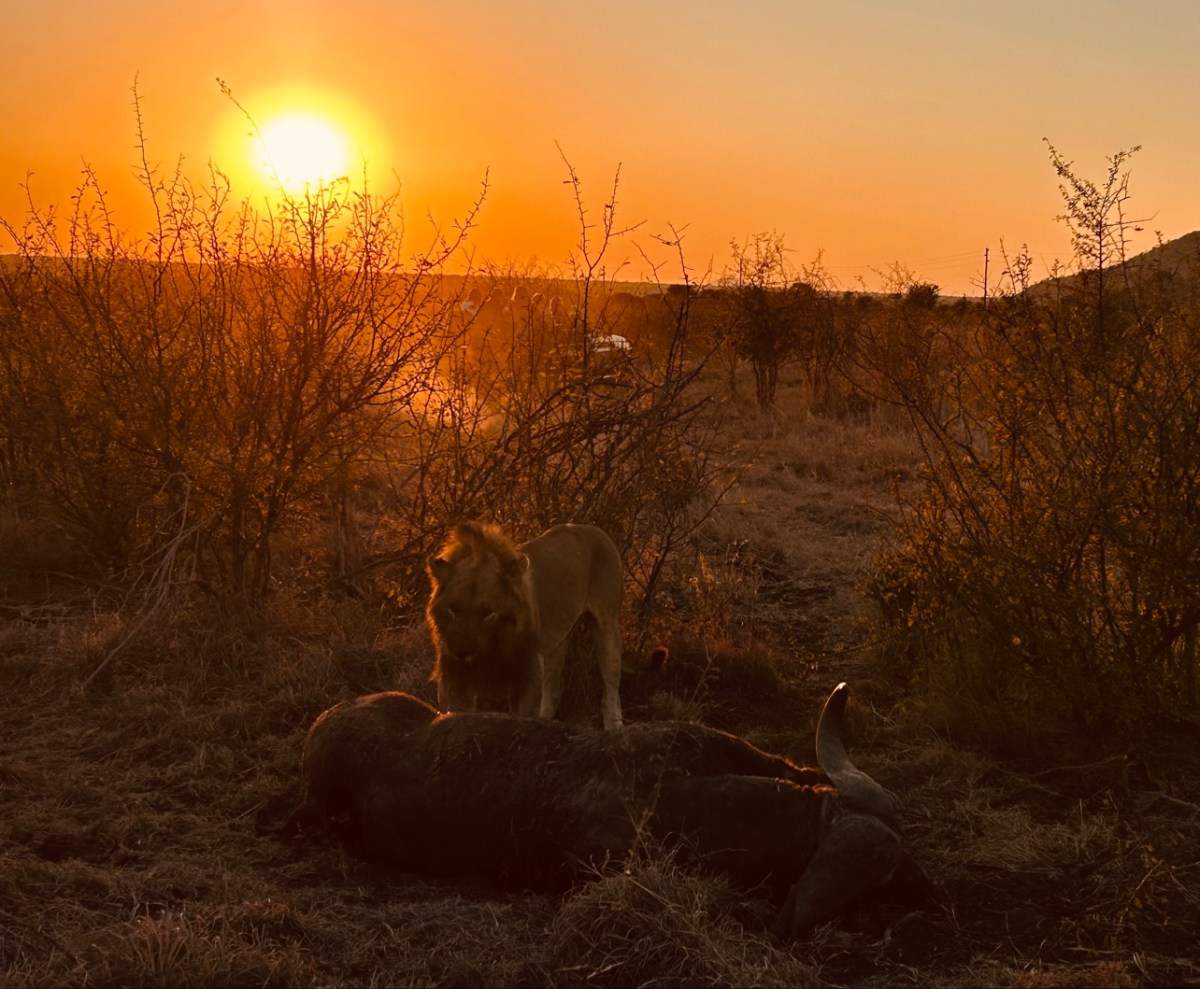
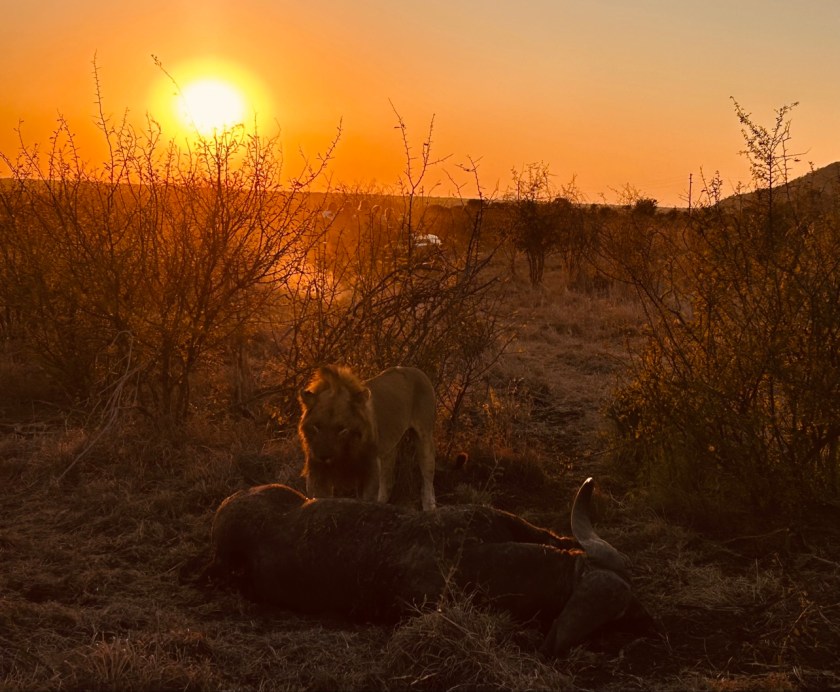
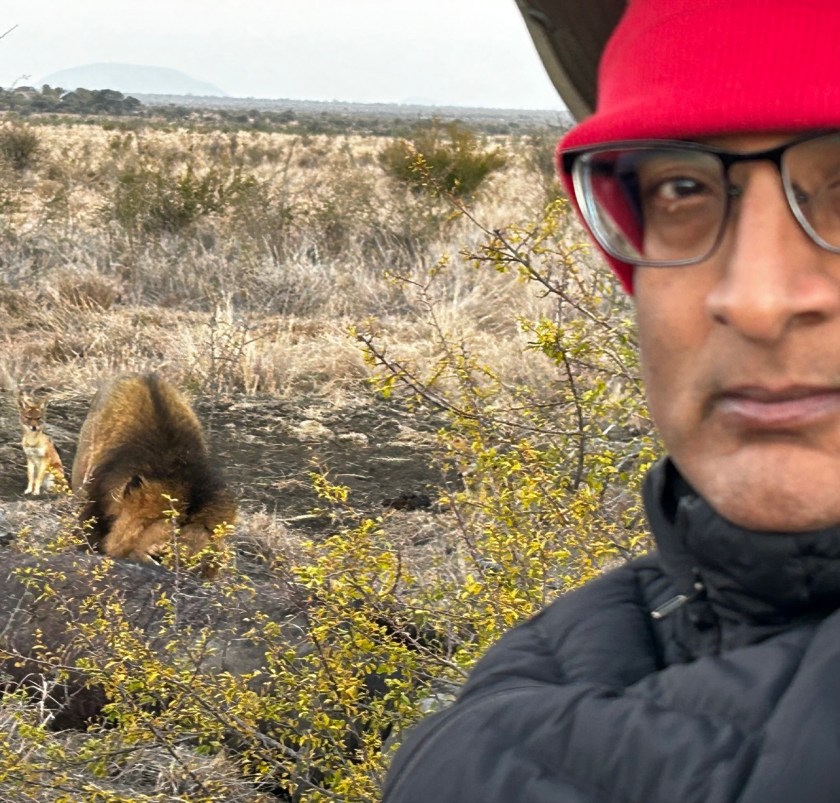
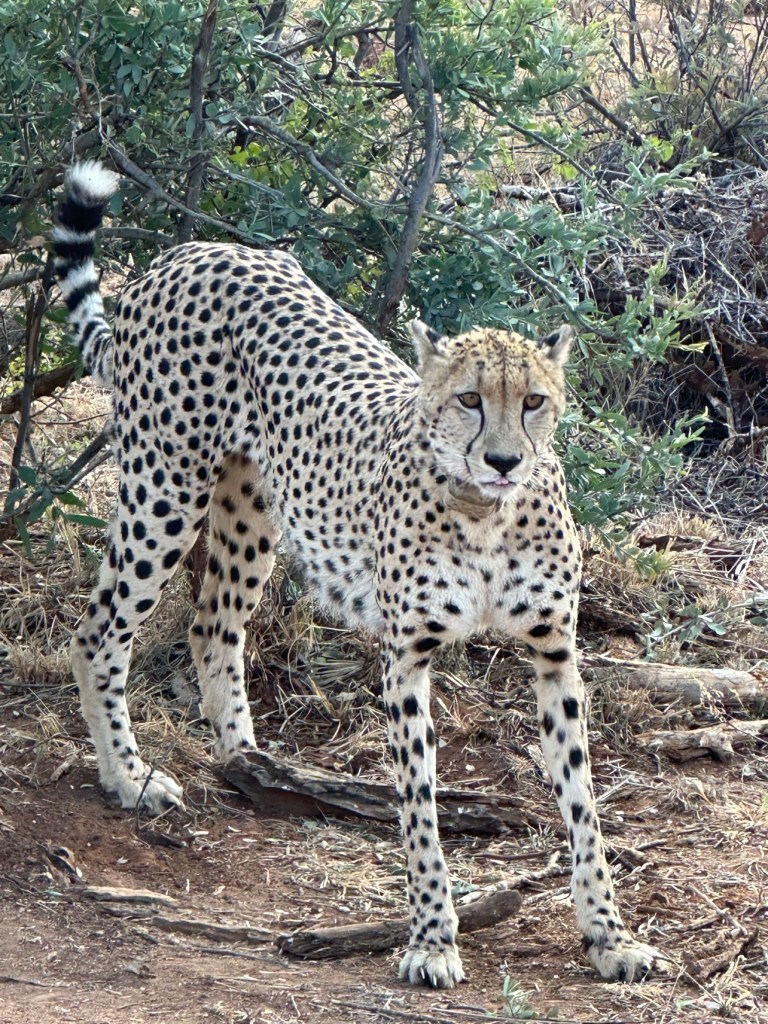
But Madikwe runs on the animals’ schedule, not the lodge’s, and the drives are where it proves it. On the evening of 22 June we found a lion standing over a buffalo carcass at sunset — an enormous animal, the day’s work done, in no hurry whatsoever — and the next morning, very early, the same neighbourhood gave us the photograph I will be showing people until they stop inviting me to dinner: me, red beanie, morning face, in the foreground; behind me, entirely unbothered, a lion stretched out in the grass; and behind him, sitting up like he had bought a ticket, a black-backed jackal. Photobombed by a jackal, at dawn, in the presence of a lion. There are worse reviews of a holiday. The lion later yawned directly at my camera with the air of a senior executive closing a meeting, and a cheetah — spotted, elegant, wearing a tracking collar and zero interest in us — stood in the bush and stared through the vehicle like we were furniture. She was right to. In Madikwe you are not the main event. That is precisely the event.
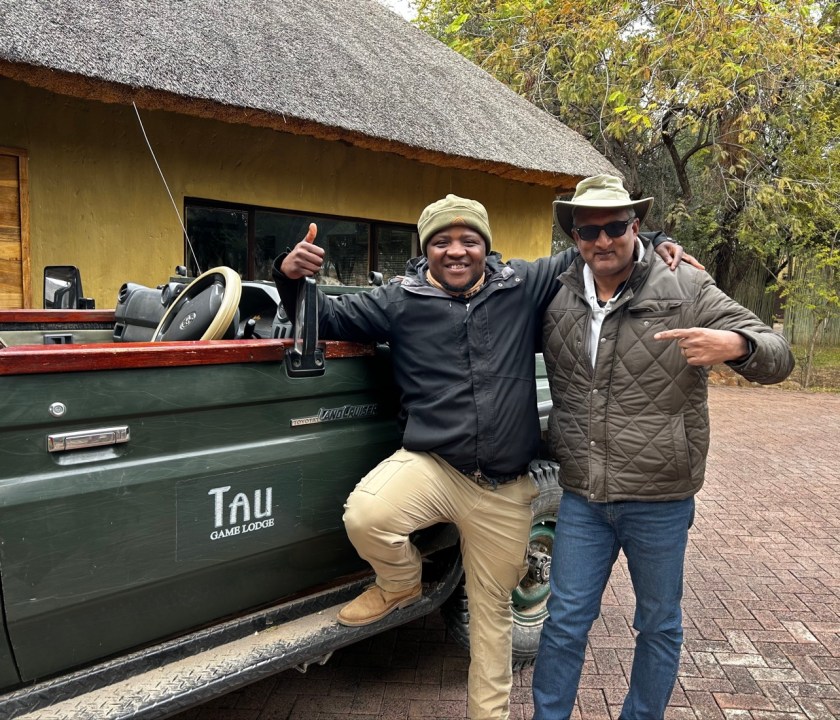
Which brings me to Silas. Every safari is, in the end, only as good as its ranger, and ours was Silas — the man in my farewell photograph, arm over my shoulder, thumb up, both of us grinning beside the Tau Land Cruiser like a doubles team that had just won something. Rangers like Silas are the real infrastructure of a place like Madikwe: tracking at dawn, reading the ground like a newspaper, knowing which lion is which and which elephant is having a day. My entire profession is built on the belief that experienced people on the ground beat any plan, process or tool you can buy. Madikwe is that belief with better scenery. Where animals roam free, as I wrote when I posted the photographs at the time, the sun is bright and the vibes are positive. I was leaving with lasting memories — beautiful Africa. I still am, a year and more later, writing this.
Travel tips, from a man who learned some of them the wet way
- Timing: June is a sweet spot with split personality — pack layers for Cape Town’s winter rain and Madikwe’s frosty dawn drives alike. The red beanie in my photographs is not a fashion statement. It is a survival tool.
- Victoria Falls: take the poncho, wear the poncho, and put everything you love in a sealed dry bag. Visit at dawn for the light and the smaller crowds. The spray is not a risk; it is a certainty.
- Table Mountain: go early, and book the cableway ahead. The mountain makes its own cloud (locals call it the tablecloth) and shuts the show down without consulting you.
- Safari: trust your ranger, sit still, be quiet, and let the bush come to you. Bring more memory cards than pride — the jackal does not do retakes.
- Driving the Garden Route: do not rush it. The road is the destination wearing a very good disguise.
- Everywhere: greet people properly, learn three words of the local language, and accept that South African time is a relationship, not a deadline. Coming from a project-controls man, that is not a complaint. It is field research.
South Africa did not feel like one trip. It felt like five — a mountain city, a wine country, a waterfall that rains upwards, a gold city with a conscience, and a wilderness that politely ignores you — stitched together by people who have been through the worst of what humans do to each other and decided, publicly and on the record, to build the opposite. The Rainbow Nation is not a finished product. It is a work in progress, executed with humour, by hand, in twelve official languages.
I have not seen the last of it. It has not seen the last of me either.
Hamba kahle, South Africa — go well. Tatenda, Zimbabwe — thank you. Until the next time the boots hit the ground.


